-
a beatles fall
yesterday as I was driving home from school a favorite song of mine began to play on my car radio: norwegian wood by the beatles. I love this song so very much because of the nostalgia it gives me, reminding me of when I would listen to beatles on loop when I was younger.
the beatles had been a fairly important part of my early life: they were the first and mainly only songs I would sing with my voice teacher from the ages of seven to ten, they brought me and my family together, and they most certainly were a staple band that I’ve held onto ever since they were first introduced to me. as I was driving home I realized what a full-circle moment I was experiencing. I can drive, I’m a senior in high school, i’m applying to colleges, yet I still hold close to me music which had immense significance to me as a child. not that I am fully an adult, if anything I’m incredibly far from it, but I do think that I could no longer be considered a kid. at seventeen I am in a highly transitional phase in my life, and for the very definition of me changing (driving: something I wished to do so often when I was young but obviously could never actually do) and the very definition of sameness (the beatles) to be occurring at the same time I find very beautiful.
in ten year’s time I will remember the moment I drove down Rumson road, singing along to Norwegian Wood, and, within that moment I heard the lyric “I told her I didn’t / and crawled off to sleep in the bath” which brought be back to a very young version of myself laughing at the fact that anyone could possibly sleep in a bath. at that instant I was both old and young, a strange phenomena that I think I will always remember.
a bit of a shorter entry but still something I found fascinating and worthy of journaling about.
<3,
blaire
-
concert for the biocene
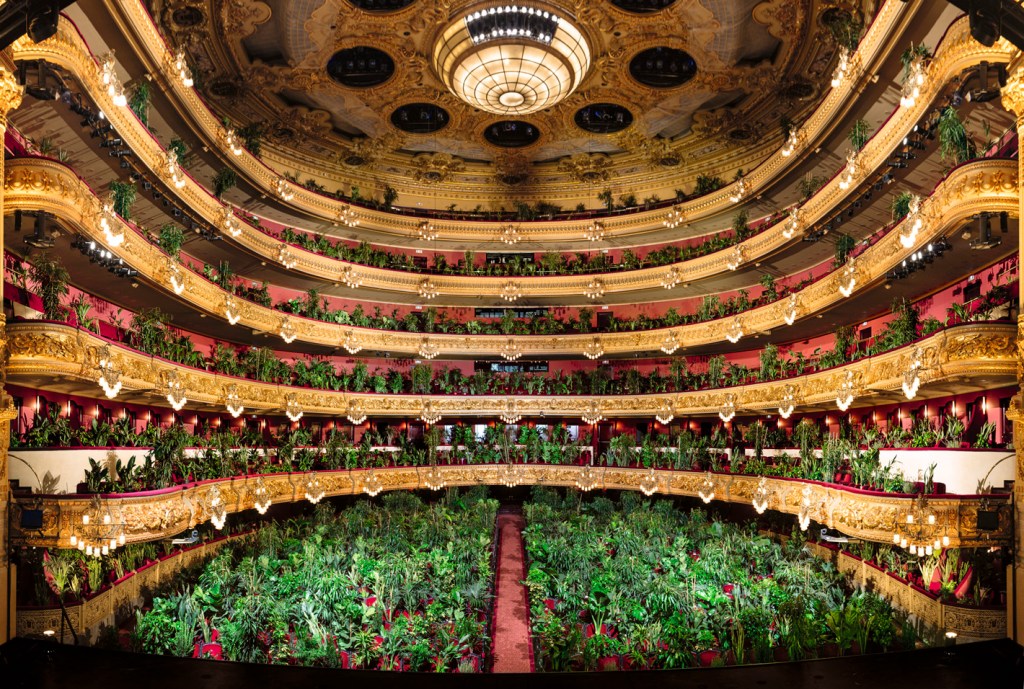
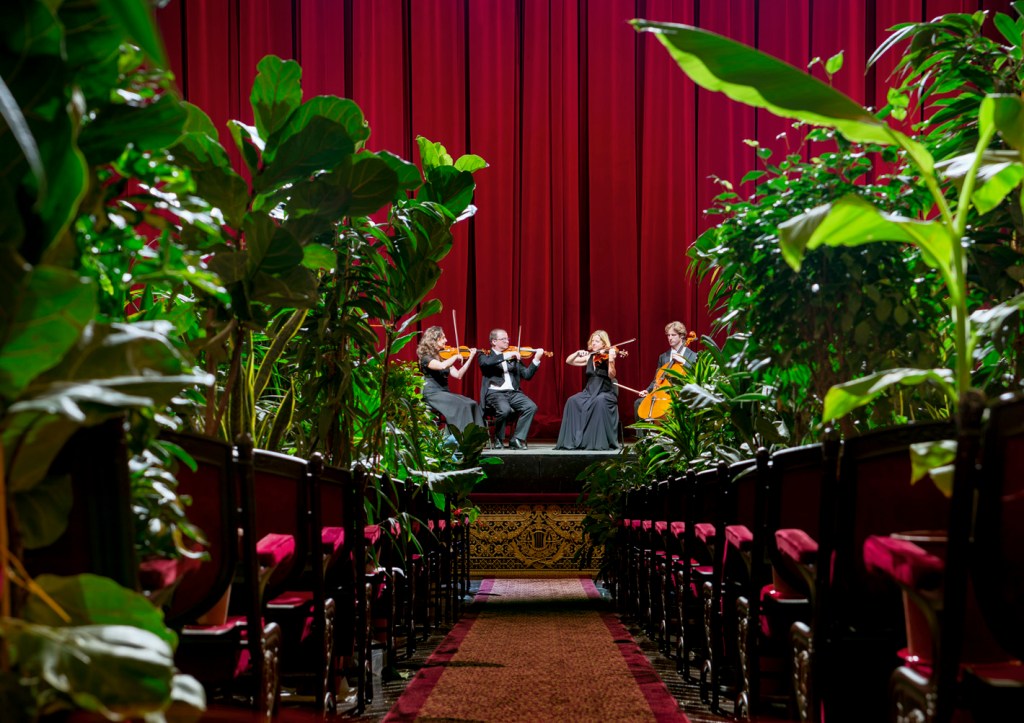
after the covid-19 lockdown was lifted in Spain, artist Eugenio Ampudia’s Concert For the Biocene was displayed in the Gran Teatro del Liceu. the exhibit occurred on June 22nd and, as can be seen through the provided images and video above, consisted of a beautiful string quartet performance to an audience made entirely up of different plant life.
this exhibition was meant to comment on “the necessity of reformulating the present from post humanist postulates and eco-social compromise” (Eugenio Ampudia), stressing the importance of connection between humans and nature. through the symbolic gesture of this concert Ampudia is calling for a necessary paradigm shift planting nature at the very center of our universe. especially in light of the covid-19 mass quarantining, the human existence has never posed more of a threat to nature. as people became increasingly isolated the surrounding ecosystems thrived, proving how detrimental our current society is to the lives of plants. by creating a performance that is usually intended for a human audience but instead is put on for 2,292 plants, Ampudia is prompting us to reconsider the way we regard nature within our lives. overall, this work has served to “rethink what happened during these months, remembering that the moment we stayed at home, nature came forward to take back what has always been hers” (Collateral).
I particularly enjoyed this exhibition because of the formality of the performance. in the beginning the typical announcement is played to turn off all cellular devices and have respect for fellow audience members, holding the plants in the audience to as high of a standard as one would hold a typical crowd made up of people. additionally, the beauty of the music and professionalism of the performers gives the impression that their audience is of high status and great importance; the spectators are deserving of the very best quality. additionally, at the very end of the performance the exhibition video edits the plants to sound as if they were clapping, personifying them into real audience members and therefore making the statement that nature is not simply something stagnant in the background of human life but rather lives and breathes just as we do and should be regarded as such.
finally, I would like to mention the importance of the viewer and how they must observe from a screen art which is very obviously meant to be experienced in person. although the plants are thriving in the audience they are still contained to their various pots and boxes, producing a sense of duplicity and lack of authenticity. this is meant to express how nature today will never be truly genuine as it has been passed through human hands and been at the receiving end of abuse from the now produced Anthropocene.
as we have emerged back to “normal” life post-pandemic I believe it is still essential to remember what happened to our environment whilst we were in confinement. when viewing the positive effects our quarantining had on local ecosystems many understood the importance of taking care of the environment and vowed to make greater efforts even when they became released from the confinement of their homes. however, as life has returned to how it was before covid so have our destructive habits. I find that this art exhibition is still entirely relevant and should be taken as an urgent message, even two years after its initial release.
WORKS CITED
https://aldianews.com/en/culture/music/concert-plants
http://www.eugenioampudia.net/en/portfolio/concierto-para-el-bioceno/
https://www.collater.al/en/concert-for-the-biocene-barcelona-music/
https://a-desk.org/en/spotlight/concierto-para-el-bioceno/
https://maxestrella.com/exhibition/concert-for-the-biocene/
I found this art exhibit from a tik tok, crazy to think what fascinating stuff my for you page recommends me. I hope it stays this way.
<3,
blaire
-
in rainbows
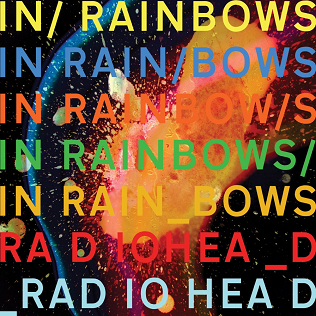
album by: radiohead
release date: october 10, 2007
on the day of this album’s release Radiohead decided to market it in a way that was widely unpopular: pay what you want (PWYW). essentially, in order to buy/download the album, the customer would input their own price as to what they saw fit for the its purchase. their was no limit or minimum to however much money a person wanted to spend, often leading to people “purchasing” the album for no money at all. here is what the website looked like:
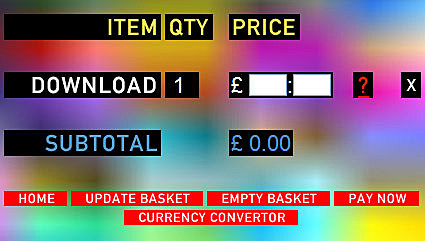
funnily enough, allowing fans to purchase in rainbows for free still did not reduce piracy rates. in fact, the album was downloaded from unauthorized sources at 10 times the rate of new releases from other top artists at the time. additionally, on file-sharing networks, 400,000 copies of in rainbows were swapped in a week, and, by the end of the month, the number was more than 2 million (npr music).
so that leaves the question: what was the purpose of selling this album through the PWYW purchasing method if it barely touched the amount of copies pirated? at the time, outside sources such as fellow artists and music critics had varying opinions, some believing that it was an important and powerful message to give the listener more input and control in the music they are purchasing, while others stated the band was setting a difficult standard for younger and newer bands to be able to financially support.
it is also important to mention that in rainbows was radiohead’s first album release without its previous record company, EMI. after the band’s world tour without the contractual obligation to make music, radiohead went on hiatus, creating a four-year gap between the release of their sixth album, amnesiac (also an amazing collection or music btw, I highly highly recommend you give it a listen) and in rainbows. overall, this puts more importance onto this specific release and leads me to believe that there was a good deal of thought that went into how the sell this album.
now my opinions: I think deciding to go with a PWYW purchase strategy was incredibly fascinating and influential. as one of the most-listened-to bands of the early 2000s, radiohead’s fanbase was huge, therefore increasing the impact of this choice. by allowing each individual to choose the price they believed the album deserved they enforced the idea that music cannot be set to a fixed price and the listening experience of each fan will differentiate how much value, both personal and monetary, the album will hold. this marketing choice gave the buyer more control over the music and, I believe, created an experience of listening and evaluating the album that took the form of a conversation with the artist instead of imposing a one-way transaction between the band and their fans. in rainbows therefore gained more personality and individuality based on whomever bought that copy of the album.
additionally, I think the personalization of the listening experience is yet another way radiohead characterizes themselves as revolutionary. although I’m sure the PWYW option was chosen by many artists before them, their popularity and influence opened the possibility up to many younger and newer creators who may follow in their footsteps.
ok here comes less interesting part: what’s in the album??
in rainbows can be categorized as alternative rock, depicting themes such as psychological terrors and fears while also playing on deep physical and emotional desires. Thom Yorke (radiohead’s lead vocalist) has stated that this album was his take on the concept of seduction songs, a series of portraits of lust and human desires that drive and control our actions (medium.com)
here is the track list — as you can see it’s one of my favorite radiohead albums (just about tied with ok computer and the bends). the tracks I like the absolute most are “jigsaw falling into place”, “weird fishes / arpeggi”, “all I need”, “nude”, and “reckoner”.

I hope you enjoyed reading about this album and found it just as interesting as I did! I always think its fun to learn something new about artists and their works after listening to them already for quite some time, it deepens my fascination and already positive opinions about the music as a whole.
<3,
blaire
also this post was inspired by this YouTube video, i 100% recommend watching it! (you have to click on “watch on YouTube” because I can’t figure out how to display it on here….)
WORKS CITED (sorry refuse to put this in MLA format I already do that too much for school)
https://binodpanda66.medium.com/radiohead-case-study-pay-what-you-want-pwyw-strategy-622569d29ac8
https://www.npr.org/sections/monitormix/2009/11/the_in_rainbows_experiment_did.html
-
my favorite paintings
art is an interest I think I will always find myself pursuing, here are some of my favorite paintings:
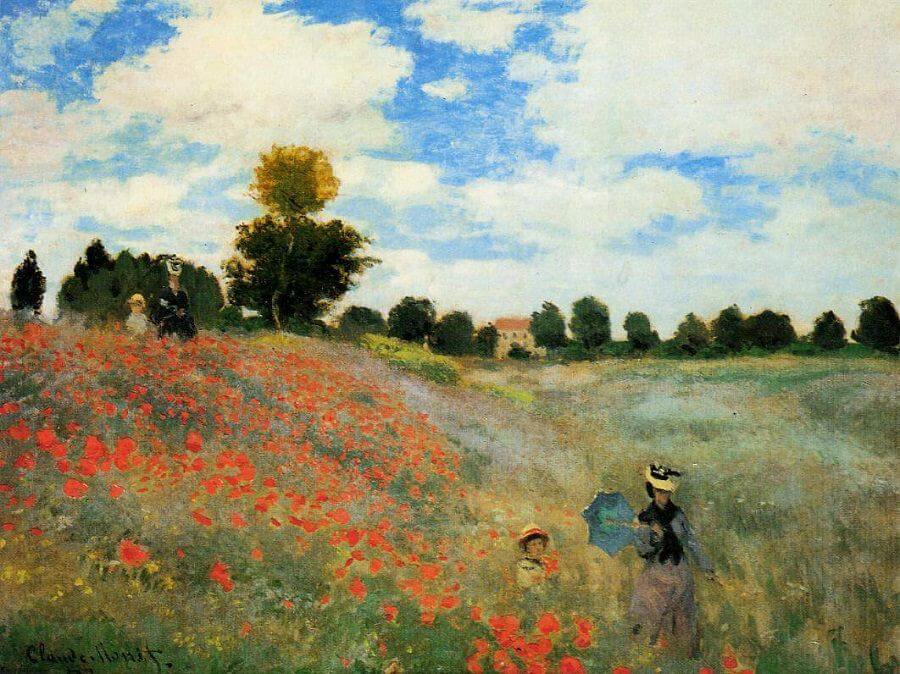
The Poppy Field near Argenteuil, 1873 by Claude Monet poppies usually sprout as a result of heavy concentration of gunpowder in a certain area, which implies that this woman and her child are walking through a battlefield. the fact that something so gruesome and purely evil like war can transform into something so absolutely beautiful (the field of flowers) amazes me and is one of the main reasons I love this painting. additionally, the color composition and the way that each of Monet’s strokes has a sort of blur to them adds to the overall aesthetic.
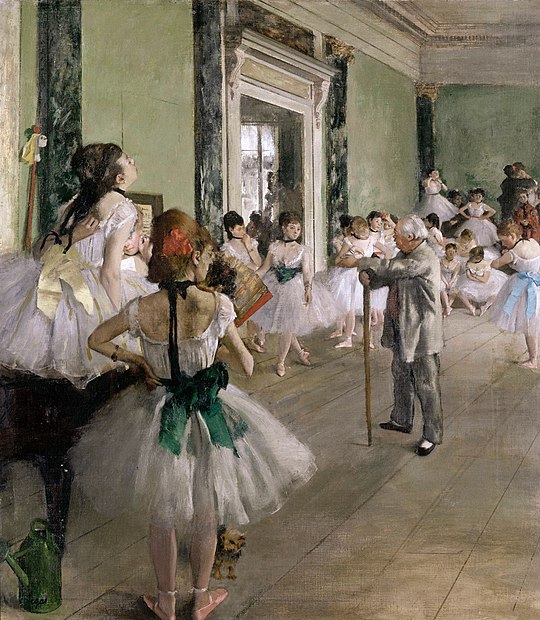
The Ballet Class, 1871-1874 by Edgar Degas this painting, for me, produces an incredibly strong sense of nostalgia. as someone who grew up in a dance environment, I particularly enjoy how it depicts the rehearsal setting and those standing on the side as a handful of girls perform the combination. as I look at this painting I recall my days as a young dancer, remembering the feelings of both boredom and attentiveness that took hold of my during my second or third hour of classes. the soft color palette portrays a mid-day atmosphere and a mood of casualty. this in combination with the way the class is depicted shows a true representation of dance and, as a result, gives this painting a very feminine feeling. I can’t quite place exactly why, but I do know that is why I appreciate this painting so much.
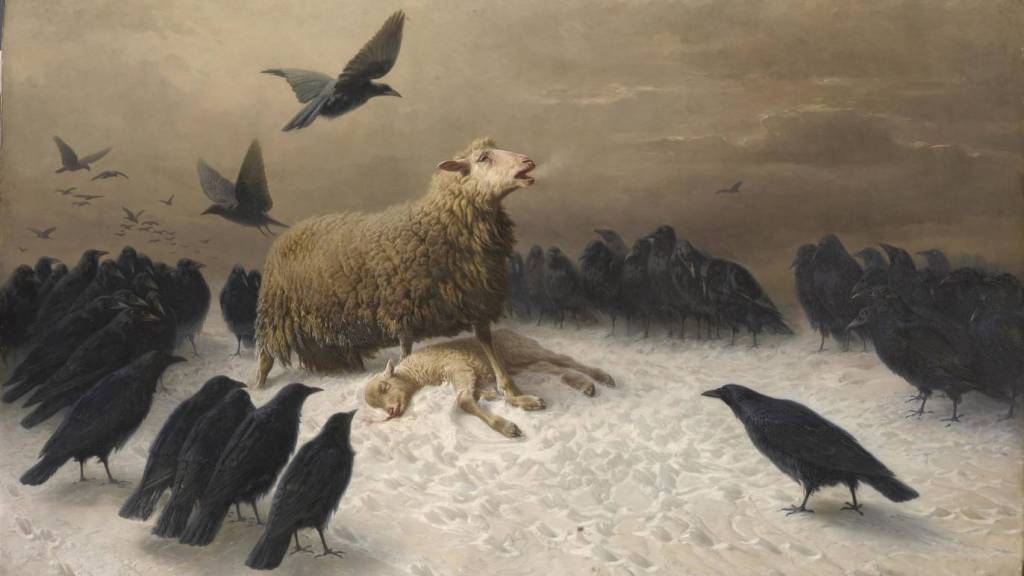
Anguish, late 19th century by August Schenck this painting, albeit tragic, is one that I find absolutely moving. there’s not much else that I can say other than the feeling portrayed in the sheep’s face is so powerful. the way that Schneck can show such human emotion within an animal shows that the difference between us isn’t as large as one might think. the way he connects you to the sheep through this raw emotion is very impressive and is what makes this painting a favorite of mine.
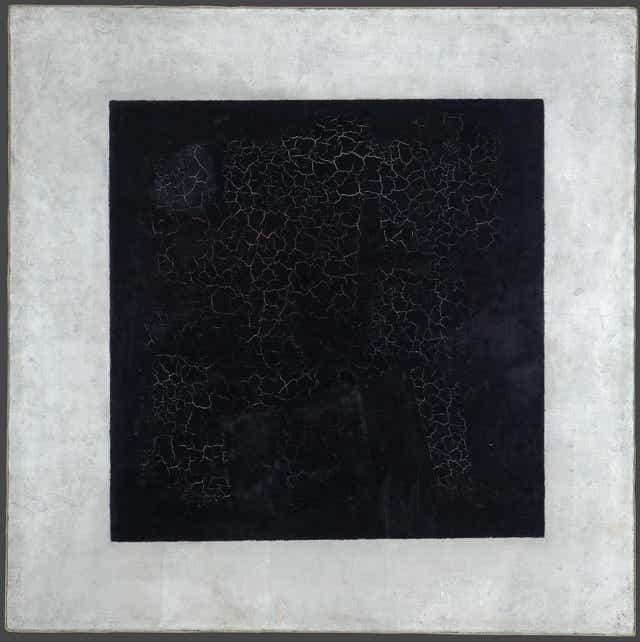
Black Square, 1915 by Kazimir Malevich this painting is less of a favorite but more so one that completely fascinates me. Malevich believed that art did not necessarily have to imitate life but rather it can simply be. with this painting, he is not making some grand political or societal statement, but rather painting a black square. this painting means completely nothing yet so very much at the exact same time, and that is what fascinates me. the fact that the painting was created to show that art does not always have to portray a message, but within that piece of artwork he is portraying that exact message. as someone who loves to analyze media down to the most minuscule details, that loophole is one that I will always find interesting.
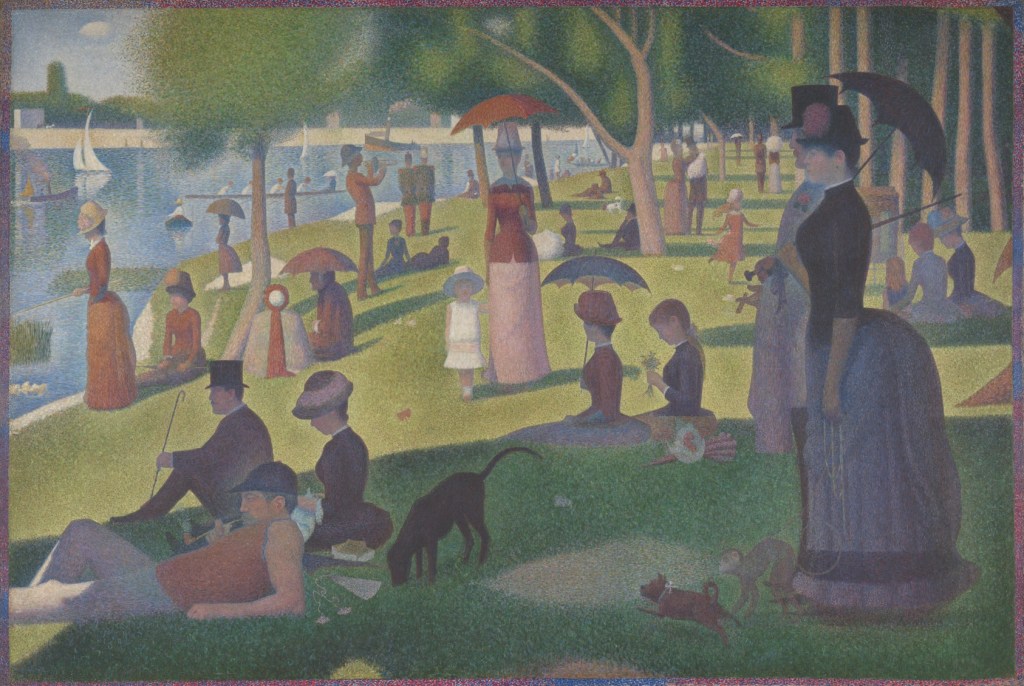
A Sunday on La Grande Jatte, 1884 by Georges Seurat ending on a more positive note, this painting is a favorite of mine purely for nostalgia purposes (similar to The Dance Class). a replica of this painting was posted at the end of a hallway at my middle school, specifically near the entrance to the third grade wing, and by seeing it it immediately takes me back to that time in my life. coupled with the fact that it is a very memorable and scenic piece, the feeling this painting gives me is one of serenity and comfort, making it the last of my favorite paintings.
anyway I hope you all enjoyed reading about some of my favorite art pieces.
<3,
blaire
-
puerto deseado poem archive
this was the second part of my final experience for my HO English II class. the assignment combined my HO Engineering II, HO Chemistry, AP World History, HO Theology II and HO French IV courses. each student contributed to the creation of a fictional city (Puerto Deseado, Argentina): in engineering we built the physical model via eco-friendly designs, in history we created a government, in theology we created a city-wide religion, and finally in this English class we had to create two things. the first of these assignments was a manifesto that I posted already and the second is the following work. we had to come up with anything that proved the city existed and could be some form of artwork that would hypothetically be displayed in the city’s archive or museum. I decided to create a short collection of poems, each written throughout the creation of this city which displayed its people and history.
From the City of TechnocratsA short collection of poems (written in June 2021)
The first of the following four poems was written in the year 1860, two decades after the end of the Industrial Revolution. Argentina had not yet modernized and kept up with the rest of the world, which was causing unrest amongst its citizens. Rafael Girondo was a middle class poet in support of industrialization and the establishment of a technocratic government, in which elected officials are brought to power based on their scientific knowledge. Girondo expresses the importance of modernization in the following poem:
An Ode to Change (Written by Rafeal Girondo)
A stretch of fabric,
Slowly drying, shrinking, and suffocating
those who reside within.
A window to opportunity
That separates thyself with no door,
But rather a single, unmovable, pane.
And until thy mallet is lifted and brought through the glass
Will thy legs be bound to the floor beneath.
Until thy water loosen the strings
That binds together that cotton which perpetually tightens.
Thou cannot be free.
Without change, thou shall be immovable, and therefore, asphyxiated
The second poem was written in the year 1863 under the same political context as the first. Movements towards an industrialized nation were becoming more popular and widespread, causing wealthy elites to protest in support of the current facist government. One of these elites was Juan Pellegrini, the author of the following poem:
The Irreversible (Written by Juan Pelligrini)
A fruit from thy tree cannot be bitten
Or the world shall fall from around itself.
Until grabbing at the walls
Which do not hold traction,
Thou cannot save
That which has been done around thee.
Impropriety is sin, as is unnecessary curiosity.
Pondering a path,
One paved with golden bricks and eternal life,
Why dost thou choose the shadows?
Why dost thou follow the serpent?
And when thy feet are bruised from the coals of the earth,
And thy wings are broken
Healing cannot be granted,
And return to the garden is a path thou shall not take.
The third poem was written by Ivonne Valencia in the year 1893. After the Argentine Civil War between the fascists and the technocrats had ended on June 19th, 1889, the citizens of Puerto Deseado gradually diffused tensions between the opposing sides. Valencia was 19 years old when the war began, and 23 years old when she wrote the following poem:
Puerto Deseado: A City of Modern Culture (Written by Ivonne Valencia)
Puerto Deseado,
A seed borne from tradition
And watered with change,
Planting its roots so as it cannot be wrenched free
By those who might wish to disrupt it.
Puerto Deseado,
A soul which has finally been quenched
After longing for balance,
It has been achieved.
Puerto Deseado,
A city no longer of war,
But hesitant satisfaction.
Where the horizon is not yet fully clear
But the feeling of dusk looms in the air nevertheless.
Puerto Deseado,
A road lined with the gold of tradition,
Although doubted, ornate with crimsons and ivory,
A beautiful contrast to the silver winds
That now sweep through the streets,
Bringing with them the scent of new beginnings.
The fourth and final poem was written in 1972 by Lucia Suarez, a junior at Puerto Deseado Public High School. The city has become a stable technocratic nation, especially emphasizing the ideals of environmentalism and leaving no carbon footprint behind. Suarez was given the assignment to write an opinionated report on individualism within their society, arguing or proving any topic they so choose. She decided to contemplate the legacy or lack thereof within a “city that does not exist”, given that it will leave no geographical imprint on the earth, in the following poem:
Unnamed (Written by Lucia Suarez)
If I escape myself for a day
And all that is there is the earth,
Lush, as it is, uninterrupted and flourishing.
And if I leave my home, and my home leaves me,
There shall be no imprint
Or legacy left behind.
It shall be as if we were not there,
Each of us having worked so diligently
Only to fade into the flowers and the overgrowth,
Without a second thought.
And this is not to say we shall pollute in order to be seen
Or we shall cut down our surroundings
So a snow angel of dirt is permanently etched into the earth.
But rather that we must be called
To create something larger than ourselves,
Larger than our small nation.
We must bury ourselves deep into the roots of a greater society
So we cannot be forgotten.
So we cannot become unnamed.
this assignment was particularly enjoyable since I never really write poetry. maybe I should get back into it? I’ll see.
<3,
blaire
-
puerto deseado manifesto
this assignment is from my honors English II course from my sophomore year. it was a part of my final experience (this is what my school calls final projects because we’re modern and cool and different). the assignment was to create a manifesto for a fictional city we were simultaneously designing throughout each of our classes. the city was located in Argentina and named Puerto Deseado. through this manifesto I attempted to convey messages of modernity, empathy (for one another and the environment) and overall progressiveness.
We shall build a city of understanding and unity, empathizing with thy neighbor and being open with our emotions so that thy neighbor is able to empathize with oneself. The first step to doing this is understanding: to communicate our emotions, it is essential to be aware of them via proper emotional intelligence and education. Our schooling shall be focused on problem-solving and empathy, building a foundation of emotional understanding amongst citizens from a young age, and furthering it throughout their early adolescent years. This will allow the second step towards a truly empathetic society, communication, to occur naturally and effectively. This communication will deeply connect our community, teaching us that as citizens and humans we are inherently deeply intertwined and that this form of connection is the key to collective prosperity. Finally, a city of empathy will be established, and within it, a community of highly emotionally intelligent and communicative citizens will flourish.
As individuals, we shall be open and vulnerable with one another, ensuring an environment in which mistakes are accepted and emotions are analyzed from a young age. In order to build a community in which it is important to understand one another, we must begin with the understanding of the self. We shall each approach life with the mindset that there is an explanation for every situation, and that both negative and positive outcomes should be explored. This shall not encourage hesitancy, but promote analysis and responsible reasoning. On an individual level, we shall each build this sense of awareness within ourselves so that a deep examination of emotions becomes a natural reaction to mistakes or bad decisions. We will become a civilization of understanding, which begins at the individual level. In closing, we shall transform ourselves into a city that understands each other and connects via the human experience as well as remains unique on an individual level with analyzing specific emotions and situations.
this final project was probably my favorite out of each of those I have completed at the end of every year i’ve been at Trinity. I enjoyed the opportunity to write creatively, which I don’t often do, and overall attempt to express my own personal values through my own reflection onto the city we as a grade were creating. the project overall was a little complicated so I hope I explained it well!
<3,
blaire
-
special relativity
this research was initially inspired by my governor’s school application for which the question was: “Discovery is the hallmark of science. Attach an essay describing one discovery in science or mathematics and the impact it has had on its field.” not only am I glad this prompted me to look into some of the most revolutionary scientific discoveries, but I gained a greater insight into the fundamental world of physics which I have always been incredibly interested in.
Before Einstein, astronomers understood the universe according to Newton’s Laws, which proved valid in nearly every application in physics and formed the basic understanding of mechanics and gravity. While Newtonian physics could describe things like motion, energy, and force, it could not explain the behavior of things that were very small or very fast, such as light. At age 16, Albert Einstein began to question this behavior and conducted multiple thought experiments in order to fill in the gaps that Newton’s Laws could not fully explain. By 1905, he proposed his theory of special relativity, which details the behavior of objects and particles moving similar to the speed of light.
Einstein stated that special relativity follows two postulates: the first being that the laws of physics must remain the same in every inertial (not accelerating) reference frame, and the second being that the speed of light (c) in a vacuum is the same for all observers. In order for both of these postulates to be proven true, we must rethink our understanding of space and time. So, let’s imagine a scenario: you are standing on a platform watching your friend pass by on a train that is traveling at half the speed of light. On that train, your friend has a laser that shines a beam of light directly in front of them to a mirror. From their point of view, the light moves straight towards the mirror and then straight back to them. However, as you are watching these events occur on the stationary platform, your perspective is different. You see the beam of light going to and bouncing off of the mirror, but as it is moving it is going diagonally, since the train that it is on is moving at half of light’s speed. Therefore, while your friend sees the shape of the light as a completely vertical line (bouncing from the laser and then straight back to them), you see it following a shape that looks like the top of a triangle.
Because speed (v) multiplied by time (t) equals distance (d), and the speed of light is always a constant, the two variables in this equation – time and distance – must change. The change of time is called time dilation. From your point of view on the platform, the light traveled a greater distance. Because vt = d, the beam of light must have traveled for longer. The amount by which time dilates for the beam of light is called gamma. Additionally, to compensate for the increase in time, the distance must then decrease, called length contraction. If on the train, your friend measures the distance between the very front of the engine and the very back of the caboose, it would actually be different than if you had measured the entire train from your point of view on the platform. This is because if something is moving relative to you, its length in the direction that it’s moving will seem shorter than it would if it wasn’t moving. To find the exact length of the object in motion, you divide the length at rest by gamma, which we found previously via time dilation. Length contraction happens for objects moving at a regular speed too, but it is so microscopically small you would never notice it.
By discovering the theory of special relativity, not only did Einstein introduce new formulas into the realm of physics, but he established that space and time are directly related. This had an extremely important effect on our ways of thinking and comprehending the universe. The language of all fundamental physics has since then been written in the terms defined by special relativity. Einstein’s discovery has had a seismic impact on the field of physics because it reimagined our view of the universe and the relationship between space and time.
VISUAL AIDS =
this image shows time dilation through a moving reference point which is the mirror on the rocket:
additionally, here is a nicer looking version of the formula to find the change in time for the moving reference frame, t’ can also be represented as gamma (γt₀)

at the time I wrote this paper I did not include my references so unfortunately I do not have a works cited. my main source of information however, was undoubtedly Mrs. Sadowski (my calculus and ap physics teacher) and the physics textbook she loaned me. (thanks mrs. sadowski!!!!)
<3,
blaire
-
top tracks this month
every month Spotify curates your “top tracks this month”, which are songs you have listened to the most out of everything (they do this too with artists, but honestly I don’t think it’s as important to me as my top tracks). I find that each month I look with absolute anticipation to find what has been on my repeat, as it serves as a sort of reflection as well as appreciation.
I often use the music I listen to as an outlet for my emotions and interests, as many people do, being that some feelings and situations can only be truly encapsulated by a certain part of a specific song. on a simpler level, I find that if I have had a rough month, the songs I use to cry to (like No Surprises and All I Need by Radiohead or Funeral by Pheobe Bridgers) happen to be on my top list. additionally, I might have songs that I only remember listening to a few times show up, as a month of fatigue and burnout often results in a month without much music. on the opposite (and notably much more positive) end of the spectrum, music that gives me energy and a sense of euphoria (like Me and Your Mama by Childish Gambino, Heavy Metal Drummer by Wilco, or even Le Carnival des Animaux: le Cygne by Saint Saens) will appear on my top tracks if I’ve had a month that has been particularly good. overall, the intricacy of so many songs can be used to describe feelings which I believe cannot be fully expressed with words, giving a true outlook of how my past month has been.
by looking back at my top tracks I feel as though I am able to get a better glimpse into myself as opposed to maybe looking through my journal, voice memos, or any other means of expression I usually find, since it shows how I’ve felt the most over a period of a month. it summarizes my overall feelings into a mere four songs, giving me a synopsis which is short and sweet. since obviously these are songs which I know quite well, I also am familiar with the moods they bring about in me, truly allowing me to know exactly how I’ve felt over the past month as these are the songs I’ve listened to, and subsequently the feelings I’ve felt, the most.
I’m never opposed to understanding myself better, and using music as a comfort and reflection I feel is an amazing way to do so. by knowing the direction my feelings have been going recently, I am aware if I should make a change, which helps me better my mental health. furthermore, its not always that deep. sometimes, I’ll look back at a month and realize that it’s been fairly good and I’ve been listening to tons of music that I quite enjoy. or, possibly, I find that the things I’ve put on repeat has simply been my studying classical music, showing me that yes, this month has contained both ap testing and finals week preparations. overall, though, I really love my top tracks. they show me things I am subconsciously feeling as I decide what playlist to put on and allow me to analyze the trajectory of the rest of the month and decide whether or not to make a change.
(if you’re curious what they’ve been so far this month, ill show you and take you through a little bit of how I look into them)
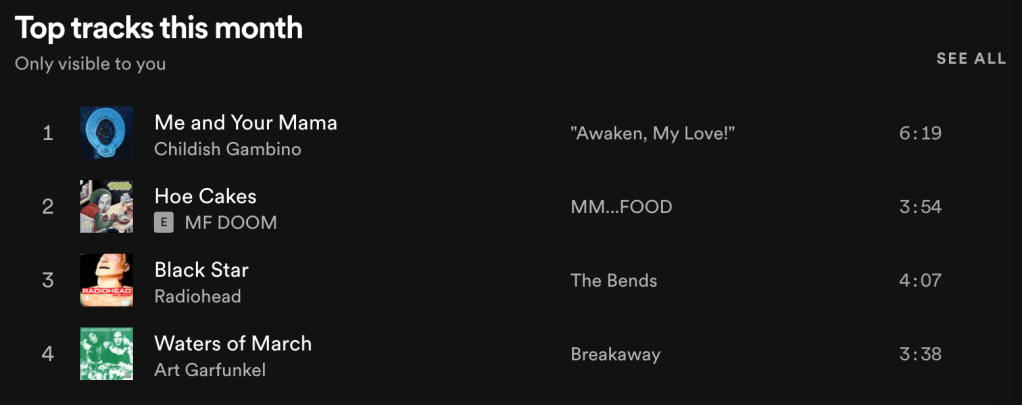
firstly, my #1 top track does not surprise me in the least, as I’ve been picking out and listening to songs that make my stomach drop (in the best way possible). once the chorus hits, I have to close my eyes and just listen to fully appreciate the beauty of this song. I find that it fits into the theme of the music I hope to play at top volume once I get my driver’s license (in a few months, woo hoo!!!!!!!!!!) which is something I’ve been especially anticipating recently. this 100% reflects some good feelings.
next, hoe cakes by MF DOOM, is just such a fun song. I’ve listened to doom for a while now but for some reason have been in a mood to put him on some more, which I am definitely not opposed to. I think this track shows that I’ve been in a “dancey” mood, meaning that I often like to just play it and lip sync in my room, or try my best to memorize all the words. it gives me energy and makes me feel happy, both of which are things I think reflect this past month. also, I play doom a lot when driving with my sister, who has just recently come home from college, so this as a top track checks out.
next, black star. honestly just such a good song. a little slower and a little more emotional, but I think that I have also felt those melancholy feelings recently, so it does make sense. I find that this is a song I like to play to simply appreciate it, as I do with many Radiohead songs, and reflects feelings of indifference and calmness.
finally, waters of march by Art Garfunkel has been a recent favorite. I forget exactly where I found it from, but it reminds me so much of early spring (which i’m sure is no surprise, the title literally has the word “march” in it) and biking through my small town. it reminds me of contentment and simple joy, both of which are feelings that I hope to carry with me into summer.
anyways, that’s all for now, I hope you’ve enjoyed my little commentary.
I think I’ll open comments for this post (if I can figure out how) so that anyone else who would like to could share some of their top tracks? overall this blog is more of something I am creating for myself to look back on the the future, but it would be cool to maybe get some interaction.
<3,
blaire
-
change and how it defines me
this is an essay I wrote for my very first assignment in my sophomore HO English II class. the prompt was simply to describe yourself currently and who you would like to be in the future (a topic which, in my opinion, is way too vague and existential to ask a class full of freshly 15 year olds). although I did spend a few days worrying about who I was and asking myself what about me really set me apart from others (if anything), I finally constructed this essay which, looking back on it almost two years later, I am incredibly proud of. while I do not like the portion about field hockey as I feel it is badly implemented and slightly interrupts the flow of the work, the wording I chose and the way I thought about the prompt now impresses me.
Change and How it Defines Me
I am defined, not by one specific situation, but rather by how I have reacted to a combination of them throughout my life. My own individuality has formed through a series of difficult experiences, each of which has shaped me into my current self. For example, I would like to say I have a small list of adjectives that I believe describe myself, but how is it I found these adjectives? How is it I know they apply? I have formed my perception of myself from observing how I’ve reacted to past experiences. I learned that I am creative by looking at situations that allowed me to demonstrate my creativity. I learned that I am a perfectionist by stepping back and removing myself from a circumstance, only to realize that I approached it with an “all or nothing” sort of attitude. In summary, I am how I react to the world.Past experiences play an important role in this way of defining myself, and when trying to narrow one down, the game of field hockey came to mind. While learning this sport was both enjoyable and difficult in and of itself, playing the game after learning the basics was the most challenging and rewarding; I found that even after understanding seemingly every play and possible strategy, there was always something more to know. This, in a way, applies to how I have viewed myself in the past, and still view myself today as I continue to grow as a person. My perception of who I am is constantly changing, as I am experiencing and learning new things about myself. However, this idea of constant change isn’t always positive. For example, because I enjoy the game quite a bit, I also invest a lot in practices, games, and overall working on and developing my skills. So, when I experience a day in which my skills are just a bit off, which is inevitable, I take it much more to heart than I should. Most of the time I find myself forgetting what it feels like to be good at the sport, and assuming I have lost all my skill. Although obviously, this is not true, I tend to hyperfocus on the small inconvenience I am having and accept it as a permanent reality, assuming that my skill has changed forever. While of course the next day I resume my usual playing level and I remind myself that off-days do occur, I think they work as an effective example to show how I, and my skills, are constantly changing. This challenge to accept the fact that my skill level fluctuates also reflects the daily changes in my character as a person as I experience life.
In my future, I hope to maintain this theme of learning, maturing, discovering, and growth. Where I would like to go in my future is not a specific place, nor can it be reached at a specific age, but rather it is a mental state I would like to achieve. Like the game of field hockey, I would like to constantly be expanding my mental skill level. When I graduate high school and college, my goal is to continue to educate myself each and every day. I hope to be in a place surrounded by people and experiences that challenge me as a person and continue my mental growth. There is no town, state, or even country that I am certain that I will end up in, but I trust that as I age I will find one. And that place, wherever it may be, is where I would like to end up in due course.
Overall, who I am as a person can be expressed using the comparison to field hockey. This sport has taught me how to experience and accept change. By putting myself through different situations and observing the outcome, I learn more about my character. Who I am is a direct result of how I’ve evolved throughout life, similar to the changes that occur in my skill level when playing field hockey. This theme of change is something I would like to remain a constant throughout my future as well. For growth, how it is shown, how it originates, and how it continues, is the very definition of myself.
i think the date I made this was around early september 2021, for reference. I’m interested to see how my writing might grow more from then until now, and further into the future.
<3,
blaire
blaire sheftel
my thoughts and interests.

 blaire sheftel